
Strategy
Over 11M Epidural Procedures Performed in the U.S. Each Year
Complications Are Common
Deep Dive Into LOR History
The standard of care to perform epidural injections uses the technique called Loss of Resistance (LOR) which was first described in 1921. Tactile feedback from the needle, and surface landmarks on the patient’s back are traditionally used to guide the epidural needle tip in to the epidural space. This technique is used to perform over 12 million epidural injections in the US annually.
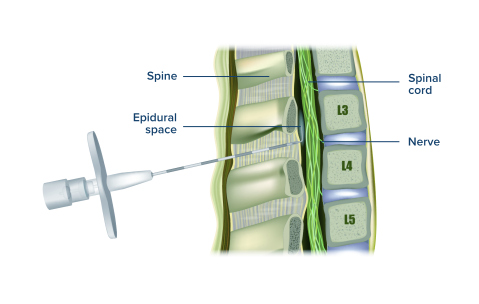
The LOR technique relies on advancing a Tuohy needle through the ligamentum flavum, to the epidural space, with constant pressure applied to the piston of a syringe, loss of resistance on the piston occurs once the needle enters the epidural space due to the change in pressure. The identification of this space, allows subsequent administration of epidural anesthesia, a technique used primarily for analgesia during childbirth and for pain management with steroids and other pharmaceuticals.
The LOR technique has remained largely unchanged since 1921, and is commonly referred to as the loss of resistance to saline technique (LORS) or its variation, the loss of resistance to air technique (LORA). The LORS technique is used more often due to the increased complication risk with the LORA technique such as pneumocephalus or air embolism.
Epidural injections using the LOR technique are associated with a significant failure rate and a long learning curve to train new physicians. Because the LOR technique is based entirely on tactile touch and feel, the training physician cannot tell if the trainee has entered the epidural space.
Examining the Market Needs
Large Market
Market Needs
Market Needs Not Being Met
Clinician Training Tool
Most new clinicians (anesthesiology residents and nurse anesthetists) are initially trained on rubber models and then on living patients. It typically takes a junior clinician about 50 to 100 “practice” patient procedures under the supervision of a senior clinician before they are ready to perform epidural procedures on their own.
Since epidural procedures are performed 100% by hand tactile touch and feel, it is difficult for the senior clinician to know how the junior clinician is progressing beyond watching the depth marks on the needle. Since the training procedure is being performed on a live patient, in most cases they must keep conversation to a minimum so as not to disturb the patient.
Use of the BrightPoint™ Epidural device provides the senior clinician with a real-time visual aid on the location of the tip of the needle and allows the trainer to provide better guidance to the trainee. This can help provide better outcomes during training procedures and reduce the overall number of required training procedures.
